Music Production Lessons

So you want to be a music producer?
Learn how to create and finish tracks.
So you want to be a music producer?
Learn how to create and finish tracks.
Build your own sound and develp it to a professional level.
CREATING MUSIC HAS NEVER BEEN MORE ACCESSIBLE
Unlock Your Creativity
If you’re not a beginner in your journey of learning music, you’ve likely encountered many teachers, each with their own unique gifts and quirks.
When I decided to teach music, I knew I wanted to approach my students in the way I wished my teachers had approached me. The key to this approach is joy.
A Simple System
Music theory, harmony, composition, sound design, mixing, and mastering are vast subjects. To make music production accessible and straightforward, I’ve developed a system that gets you creating your own music in just a few hours.
By working with loops, you dive straight into the creative process, making it a fun and engaging experience from the start.

Producer, DJ, Coach

Producer, DJ, Coach
Learn music production and create your own tracks from scratch.
These private music production lessons are designed for beginners and producers of all levels who want to develop their sound and produce professional-quality electronic music.
Immediate Engagement
Think of music production as a collage of sounds. This method of immediate engagement creates a positive feedback loop, making the process addictive and enjoyable.
Within a week, you could have your own short track ready to export, share with friends, upload, and enjoy.
Your Learning, Your Choice
From that point on, you are in control of your learning journey. There’s no need for my aesthetic to be imposed on you.
If you want to delve into creating your own drums, we’ll explore drum production. Curious about crafting fat basslines? We’ll dive into synthesizers.
My goal is to help you bring your vision to life and to teach you how to fish, not just give you fish.
Examples of my work
Psytrance
Melodic Techno
House
Downtempo
Hip-Hop
THIS IS THE GOLDEN AGE OF ELECTRONIC MUSIC
My Method
I’ve developed a system that allows beginners to start making music immediatly.
By working with loops, we dive straight into the creative process. This collage-like approach to production sparks a positive feedback loop, making the process both addictive and incredibly enjoyable.
Within a few weeks, you can have your own short track ready to export, share with friends, upload, and enjoy.
From that point on, you are in control of your learning journey.
My goal is to help you bring your vision to life and to teach you how to fish, not just give you fish.
Testimonials
Level 1 : Beginner
Step into the world of music production by mastering the essentials. Learn how to navigate your DAW (Digital Audio Workstation), create beats, and arrange your first track with confidence.
This level is designed for those new to production, providing clear, structured lessons on building drum patterns, adding melodies, and creating cohesive loops. By the end, you’ll have a strong grasp of the fundamentals and a solid first track to share.
Level 2 : Intermediate
Elevate your production skills with techniques that give your music professional polish. Dive deeper into sound design, layering, and mixing, while exploring automation to add movement and excitement to your tracks.
At this stage, you’ll learn to refine your arrangements, blend sounds harmoniously, and introduce dynamic builds and drops that captivate listeners. You’ll also gain insights into crafting tracks that stand out in the competitive music landscape.
Level 3 : Advanced
Perfect your sound and take your tracks to the next level with advanced techniques. Master complex sound design, explore experimental structures, and learn how to add depth and character to your productions with cutting-edge effects and tools.
This level also includes guidance on mastering your tracks for professional release, tips on creating a unique artistic identity, and insights into navigating the music industry, ensuring your work makes a lasting impact.
Maximize Your Learning with Recorded Lessons
I encourage all my students to record our lessons.
This way, you don’t need to stress about remembering everything.
Any time you need, you can review our sessions and recall the information you need.
This approach allows us both to make the most of our time together.
Maximize Your Learning with Recorded Lessons
This approach allows us both to make the most of our time together.
Examples of my work
Downtempo
Psytrance
Melodic Techno
House
Hip-Hop
Drum & Bass
Testimonials
Meet your teacher

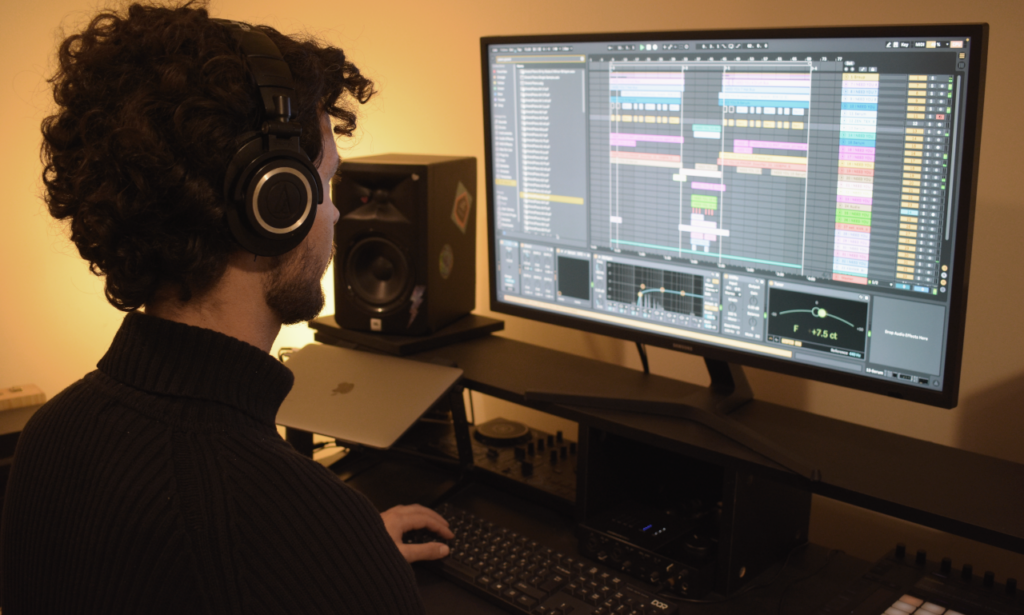
Hello, I am Orfeas. I am a music producer, DJ and music coach. I have a master’s degree in electroacoustic composition from the Ionian university and I have been teaching since 2023. I am active in EDM since 2019 and it’s the biggest passion of my life.
I’ll be very happy to teach you everthing I know!
FAQ
Is this for beginners, or do I need experience?
The private music production lessons are suitable for all levels.
Whether you’re a complete beginner or an experienced musician, you’ll benefit if you’re interested in music production. Even if you’re starting from zero, we can build your skills step by step together.
If you already have a musical background, that experience will naturally help you progress faster in production. And if you’re already producing music, the lessons can help you refine your technique, learn more advanced concepts, and further develop your artistic identity.
What equipment do I need to get started?
You’ll need a computer, Ableton Live, and either headphones or speakers. A MIDI keyboard/controller is also helpful, but not necessary when starting out.
Your computer doesn’t need to be cutting-edge. Music production is usually far less demanding than video editing or gaming. If your computer runs smoothly for everyday use and web browsing, it’s probably already capable of handling beginner-level music production.
How can I get Ableton Live?
There are several ways to get Ableton Live depending on your budget and needs.
Ableton comes in different versions (Lite, Intro, Standard, and Suite) each with different features and pricing. For beginners, even the most basic versions are more than enough to start making music.
Many MIDI controllers also include Ableton Live Lite for free, which comfortably covers the needs of most beginners.
There’s also a rent-to-own option, where you pay monthly installments and receive a full license once the payments are completed.
What speakers or headphones do I need for music production?
One of the biggest technical challenges in music production is creating a mix that sounds good across as many playback systems as possible: headphones, phones, cars, clubs, laptops, and more.
To achieve that, we need audio playback that’s as accurate and “honest” as possible. In a studio environment, that usually means two things:
- flat headphones or speakers that don’t artificially color the sound,
- and a room with minimal acoustic reflections.
Most consumer speakers are intentionally “colored” to make music sound more exciting. But when mixing, we actually want the opposite: a more objective and transparent representation of the sound.
Because properly treated studio spaces can become expensive, most producers start with a good pair of flat studio headphones and then test their mixes on multiple listening systems.
You can even begin with simple headphones like Apple EarPods. Later on, as you improve, you can invest in studio headphones, studio monitors, and an audio interface.
Does it work on Mac and Windows?
Yes. Ableton Live works on both Mac and Windows.
Mac computers tend to offer a slightly more stable and plug-and-play experience when it comes to audio and drivers, but a good Windows computer can absolutely handle professional-level music production without limitations.
Do I need a MIDI keyboard, or can I work without one?
You can absolutely start without a MIDI keyboard. It’s not required to learn music production or create music in Ableton Live.
That said, a MIDI keyboard can make both production and music theory much easier and more intuitive to learn. Even a small 2-octave keyboard with a few knobs can make the creative process feel far more hands-on and enjoyable.
There are excellent options available even under €100, so it’s usually a worthwhile investment as you progress.
How exactly does the “loop-based system” work?
The journey of music is, thankfully, endless. You could spend years studying theory before ever creating your first track. But I believe hands-on creation is just as important as theory. That’s why I developed a system that allows even complete beginners to jump straight into the creative process.
In electronic music and EDM, producers often work with ready-made audio material like samples and loops from sample packs. By using these tools, you can start building your own tracks very early on, almost like creating a musical collage.
Through that process, you gradually begin to understand how structure, rhythm, melody, and arrangement actually work in practice, not just in theory.
As you progress, the lessons evolve around your interests and goals. We can dive deeper into whatever pulls you in most: drums, melodies, sound design, music theory, mixing, recording, and more.
How long does it take to see results?
That depends on several factors: your musical background, your comfort level with computers, but most importantly, the amount of time and consistency you can dedicate to practicing.
If you already play an instrument or have experience as a DJ, you’ll probably progress faster because you’ve already developed musical intuition and taste. Being comfortable with computers also helps a lot in the beginning, since music production is closely tied to technology.
But the biggest factor is consistency. If you practice regularly, within a few weeks you can already start creating your first complete mini tracks and begin understanding how music production actually works in practice.
Reaching a truly professional sound takes longer. But the creative enjoyment and visible progress begin much earlier.
Do I need to learn music theory?
That depends on your goals.
Music is a language, and music theory is, to some extent, the grammar of that language. Can you learn a language without grammar? Maybe. But usually your ability to express yourself will be more limited.
If your focus is a more atmospheric or texture-driven genre, like Industrial Techno for example, then the emphasis may lean more toward sound, rhythm, and music technology rather than complex harmony.
But if you want to write expressive melodies, richer harmonies, and generally have more freedom in composition, then music theory becomes extremely valuable.
The good news is that theory doesn’t have to feel like dry academic study. We can learn it gradually through the creative process itself and through the actual music you’re making.
How do we go from a loop to a full track?
One of the biggest problems in music production is that many people get stuck making loops forever and never actually finish tracks. Usually that happens because they try to write music linearly (from beginning to end) exactly the way the listener hears it. In practice, that’s often extremely difficult.
In these lessons, you’ll learn arrangement and workflow techniques that make finishing tracks feel far more natural and manageable.
The main idea is simple: we start with the strongest part of the track first, usually the drop, climax, or main section. Once the core 8 or 16 bars are working, we can then build the rest of the arrangement around that idea: the intro, breakdown, build-up, transitions, and so on.
That way, instead of spending all your creative energy at the beginning and running out of ideas halfway through, you build the track strategically around its strongest core.
Can you teach the specific genre I want to make?
My specialization is electronic dance music (EDM) and modern music production.
I’ve worked extensively with genres like Psytrance, Downtempo, House, Techno, and Hip Hop. Genres like Dubstep and Drum & Bass are also very approachable within this framework, since they rely on many of the same core principles around sound design, arrangement, mixing, and mastering.
If your interests are far outside electronic music or Hip Hop, though, you may benefit more from working with someone who specializes more deeply in that particular genre.
How do the online lessons work?
The lessons are held online through Discord or Zoom, with screen sharing so we can work directly on your project together.
We also use a free plugin called SonoBus, which allows us to share high-quality audio in real time with very low latency.
That means you can work on your project while I hear exactly what you’re doing live, and I can demonstrate ideas, edits, and techniques in real time, almost like being in the same studio together.
I already use another DAW. Do I need to switch to Ableton Live?
No, switching DAWs is not necessary.
If you already work in another music production software, we can build on what you already know and focus on improving your music and production skills independently of the software itself.
The interface may differ from DAW to DAW, but the core principles of music production (arrangement, sound design, mixing, and track structure) remain fundamentally the same.
And if at some point you decide to move to Ableton Live, we can do that gradually and in an organized way.
What happens after the lesson?
At the end of each lesson, I’ll give you exercises and homework so you can continue practicing on your own.
Between lessons, you can also contact me through WhatsApp or email, send me the tracks you’re working on, and receive feedback. You can also ask for help whenever you get stuck on something.
Can these lessons get me to the point where I can release my own music?
Yes, if you work consistently and follow the process seriously.
The goal of the lessons is to help you reach a point where you can finish tracks with the structure, sound quality, and mix needed for release-ready music.
And when the time comes, I can also guide you through the practical side of releasing music: uploading to platforms like Spotify, YouTube, and SoundCloud, as well as understanding the basic options for music distribution.